Reading Room: inseparable assembly
at The School for Temporary Liveness, Vol. 4


After Hours Film School: rehearsals
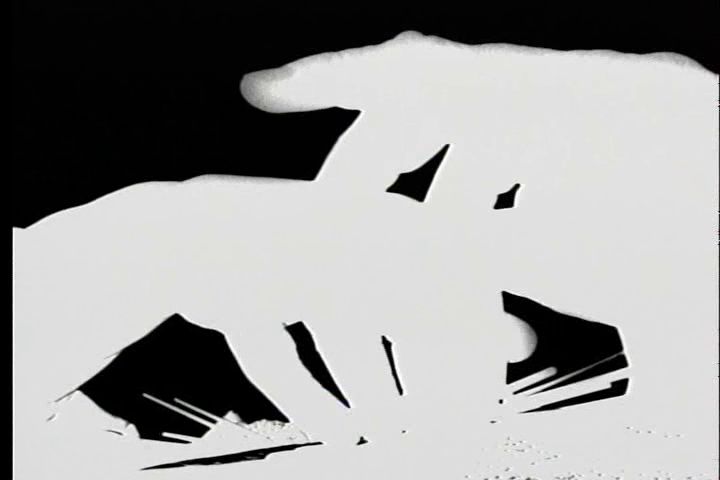
Still from Phill Niblock, The Magic Sun, 1966. 16mm transferred to digital, b&w, sound, 16:44 min. Courtesy of Corbett vs. Dempsey, Chicago
Location
The Kitchen at Westbeth
163B Bank Street
4th Floor Loft
New York, NY 10014
About the event
After Hours Film School presents a screening program about rehearsal, improvisation, and musical and embodied interpretation as forms of collective study and assembly. Thinking with cinema as a medium that registers bodies in motion and records their sonic traces—jamming, walking, dancing, coalescing, waving an arm through the screen as the saxophone breathes out—the program asks: how can cinema choreograph its own movements and figurations of the social?
rehearsal is organized on the occasion of the School for Temporary Liveness Vol 4 (July 10–12, 2025), as part of the Wendy's Subway Reading Room, inseperable assembly, which invites shared study, reflection, and gathering. Envisioning the reading room as a space of social choreography, inseparable assembly iterates across a selection of titles centering performative, improvisational, and pedagogical practices; and citations and fragments that encourage self-guided movement and act as offerings or prompts for writing and annotation. Learn more here.
After Hours Film School is a semi-monthly workshop and screening series at Wendy’s Subway devoted to new currents in cinematic practice. The series invites moving-image makers to share new work or work-in-progress and engage around methodology, production, and key questions animating their work. After Hours is organized by Kirsten Gill and Rachel Valinsky.
Program
+ The Otolith Group, People to be Resembling, 2012. HD video, color, sound, 21:42 min.
+ Phill Niblock, The Magic Sun, 1966. 16mm transferred to digital, b&w, sound, 16:44 min.
+ Kevin Jerome Everson, If You Don’t Watch the Way You Move, 2023. Color, sound, 12:19 min
+ Sky Hopinka, Subterranean Moon, 2024. HD video, color, stereo, 29:45 min.
Runtime: 68 minutes
The Otolith Group, People to be Resembling, 2012
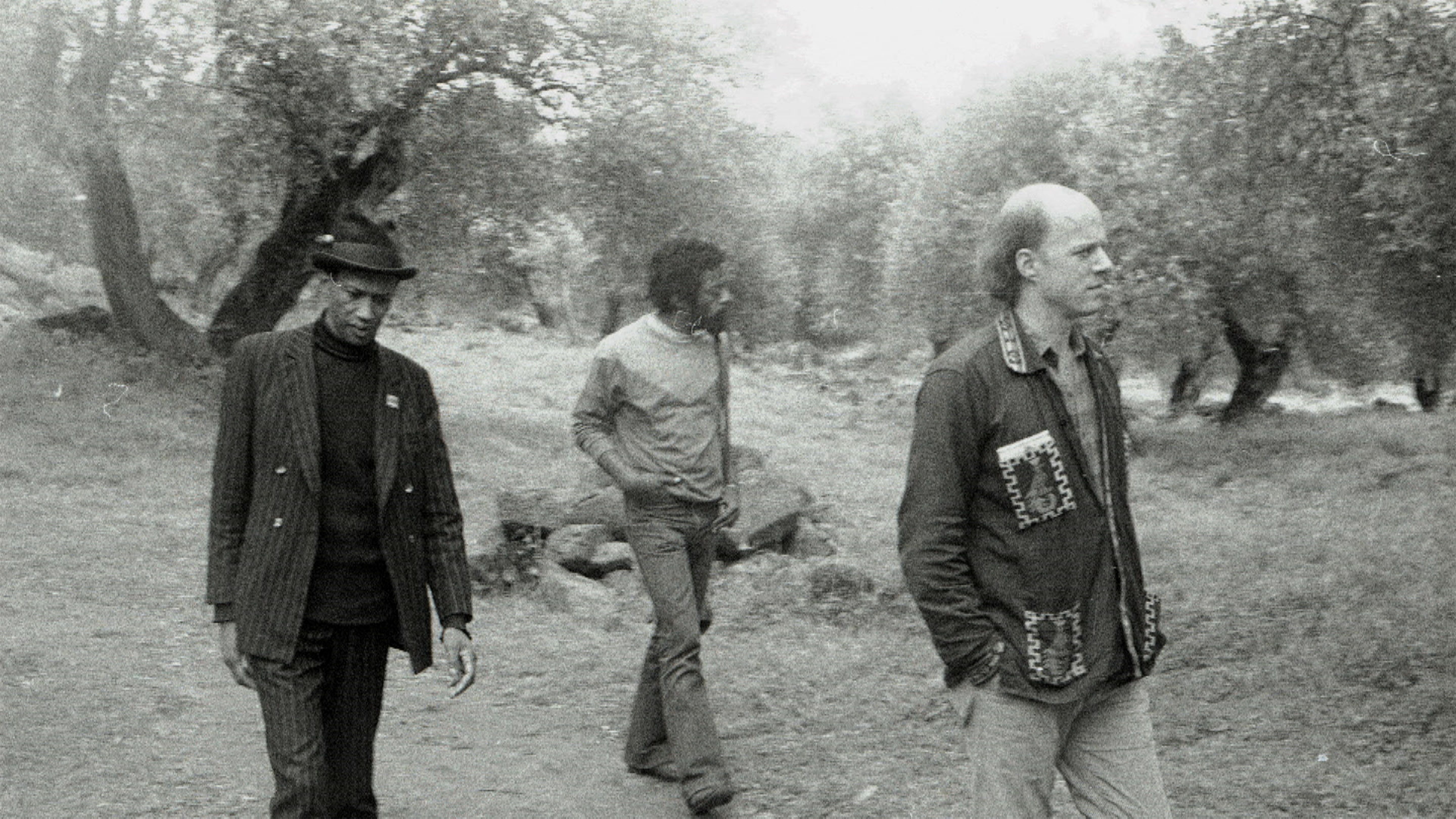
Still from the Otolith Group, People to be Resembling, 2012. HD video, color, sound, 21:42 min. Courtesy of the artists and Lux, London
People to be Resembling can be described as a five-sided portrait of the methodologies of the post-free jazz, pre-world music trio Codona, founded by multi-instrumentalists Collin Walcott, Don Cherry, and Nana Vasconcelos in 1978. Consisting of stills by renowned photographers Roberto Masotti and Isio Saba, newly filmed and archival footage and original music performed by musician Charles Hayward, People to be Resembling reimagines the poetics of permutation that informed the sonic geography of the first Codona album recorded with ECM in September 1978. It returns to this moment in order to redream the recording process at Tonstudio Bauer as a meditation upon the relations between visual anthropology, anti-colonial choreography, nuclear annihilation, and Weltmusik. In its arrangement of positive and negative with color, black and white, still and moving imagery, The Otolith Group's People to be Resembling stages an experiment in mnemonic cohabitation inspired by the visionary music of Codona.
Courtesy of the artists and Lux, London
Phill Niblock, The Magic Sun, 1966
Still from Phill Niblock, The Magic Sun, 1966. 16mm transferred to digital, b&w, sound, 16:44 min. Courtesy of Corbett vs. Dempsey, Chicago
Composer, photographer, and filmmaker Phill Niblock's immaculate experimental film, The Magic Sun, features a soundtrack by bandleader and extraterrestrial Sun Ra and the members of his Solar Arkestra, and is composed of rare moving footage of the band in this era. Shot in the mid-sixties, when the Arkestra was based in New York, this film was produced using a unique black and white negative process (with no internegative) and ultra-tight close-ups on the moving hands and mouths of the musicians that grow increasingly frenetic as the images seamlessly turn from negative to positive. The result is a virtually abstract music film, edited with pinpoint precision, that emphasizes the independence of image and sound, save a single magical moment of synchronization at the film's end.
Courtesy of Corbett vs. Dempsey, Chicago
Kevin Jerome Everson, If You Don’t Watch the Way You Move, 2023
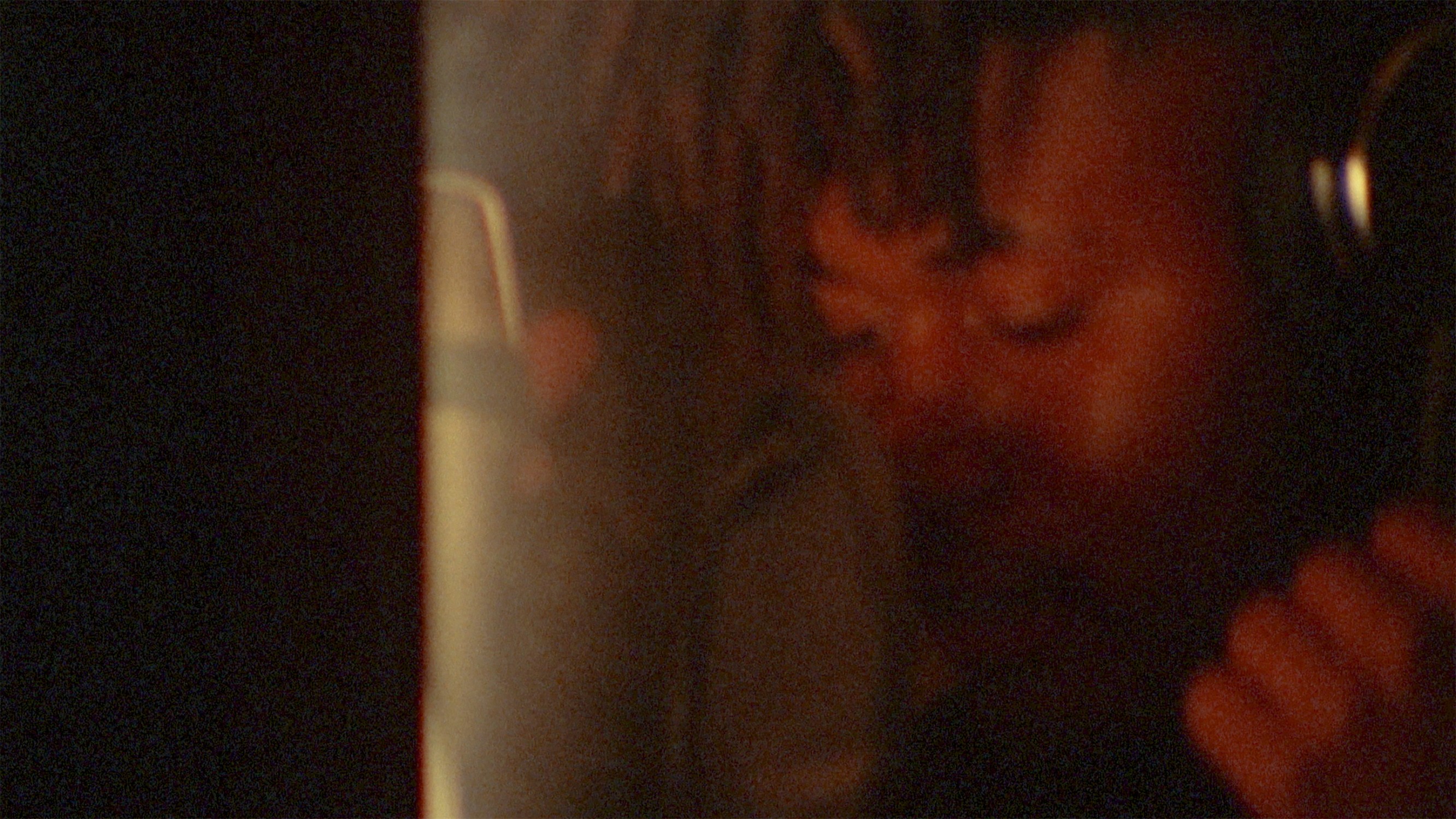
Still from Kevin Jerome Everson, If You Don’t Watch the Way You Move, 2023. Color, sound, 12:19 min. Film still © Kevin Jerome Everson; courtesy the artist; trilobite-arts DAC; Picture Palace Pictures
John Cage’s renowned composition receives a compelling remix while, in the recording studio of Jermaine "Country Blakk" Brown in Columbus, Mississippi, Derek “Dripp” Whitfield Jr. and Taymond “ChoSkii” Hughes of the group BmE lay down a new track, in the studio of Interpolating the worlds of hip-hop and mid-century experimental music, Kevin Jerome Everson’s If You Don’t Watch the Way You Move both documents the labor process of the recording studio and subtly alludes to the filmmaker’s own work of structural assemblage.
Featuring:
Derek "Dripp" Whitfield Jr.
Taymond "ChoSkii" Hughes
with Jermaine "Country Blakk" Brown
Director/Camera/Editor: Kevin Jerome Everson
Producers: Kevin Jerome Everson, Madeleine Molyneaux
Editor: Kevin Jerome Everson
Sound: Derek Whitfield Sr.
Courtesy of the artist, trilobite-arts DAC, and Picture Palace Pictures
Sky Hopinka, Subterranean Moon, 2024
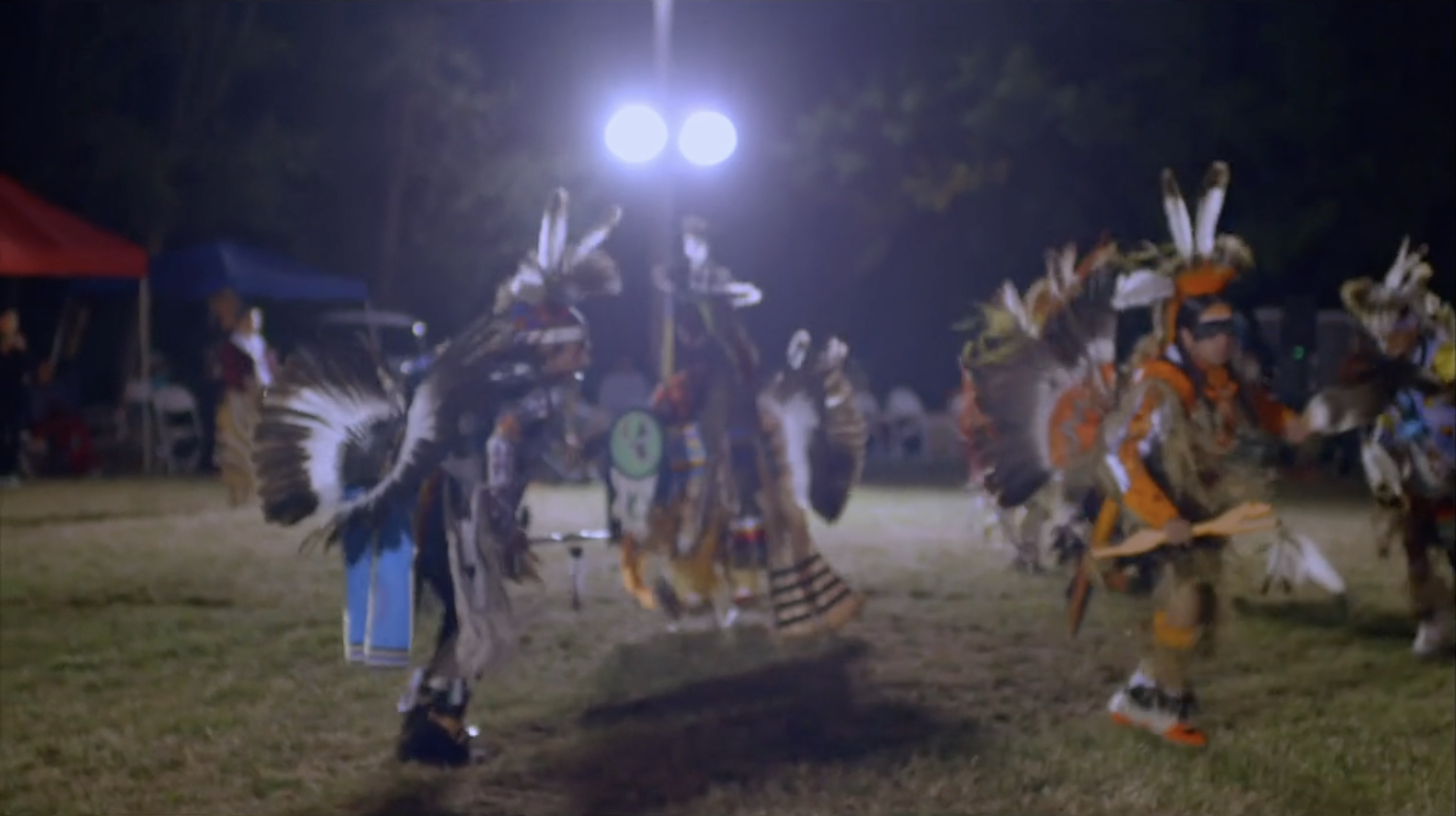
Still from Sky Hopinka, Subterranean Moon, 2024. HD video, color, stereo, 29:45 min. Courtesy of the artist
A long take of scenes from a powwow outside of Seattle, organized by Hopinka for his upcoming feature film, Powwow People. Deftly emceed by Ruben Little Head, the film guides the viewer and the audience through a 30-minute-long take of a Northern Traditional dance special. For Hopinka, the movement of his embodied camera is a vehicle for relating to and listening to the beings and ancestors who haven't been repatriated by museums and institutions, all the while questioning different forms of confinement they must contend with.
About the artists
Kevin Jerome Everson (b. 1965 Mansfield, Ohio; lives and works in Charlottesville, VA) is the Commonwealth and Ruffin Foundation Distinguished Professor of Studio Art and Director of Studio Arts at the University of Virginia. His art practice encompasses photography, printmaking, sculpture, and film—with twelve features and over three hundred solo and collaborative short-form works to date. He has been recognized with the Guggenheim Fellowship, Rome Prize, Alpert Award, Heinz Award, and Berlin Prize, and with commissions and grants from Ford Foundation/Just Films, Knight Foundation, and Creative Capital. His work screens and exhibits internationally at festivals, cinemas, museums, and biennials, and has been the subject of retrospectives at the Whitney Museum of American Art; Cinéma du Réel/Centre Pompidou; Museum of Modern and Contemporary Art, Seoul; and the Harvard Film Archive.
Sky Hopinka (Ho-Chunk Nation/Pechanga Band of Luiseño Indians) was born and raised in Ferndale, Washington, and Palm Springs, California. In Portland, Oregon he studied and taught chinuk wawa, a language indigenous to the Lower Columbia River Basin. His video, photo, and text work centers around personal positions of Indigenous homeland and landscape, designs of language as containers of culture expressed through personal, documentary, and nonfiction forms of media. He was a fellow at the Radcliffe Institute for Advanced Study at Harvard University in 2018–2019, a Sundance Art of Nonfiction Fellow for 2019, an Art Matters Fellow in 2019, a recipient of a 2020 Herb Alpert Award for Film/Video, a 2020 Guggenheim Fellow, and a 2021 Forge Project Fellow. He received the 2022 Infinity Award in Art from the International Center of Photography, the 2023 Baloise Art Prize at Art Basel, and is a 2022 MacArthur Fellow. Sky currently lives in Brooklyn, New York, and is an assistant professor in the department of Art, Film, and Visual Studies at Harvard University.
Phill Niblock (1933–2024, USA) was an artist whose fifty-year career spanned minimalist and experimental music, film, and photography. Since 1985, he served as director of Experimental Intermedia, a foundation for avant-garde music based in New York with a branch in Ghent, Belgium, and as curator of the foundation’s record label, XI. Known for his thick, loud drones of music, Niblock’s signature sound is filled with microtones of instrumental timberres that generate many other tones in the performance space. In 2013, his diverse artistic career was the subject of a retrospective realized in partnership between Circuit (Contemporary Art Centre Lausanne) and Musée de l’Elysée. The following year Niblock was honored with the prestigious Foundation for Contemporary Arts John Cage Award.
The Otolith Group was founded in 2002 by Kodwo Eshun and Anjalika Sagar. Its work is research-based and spans the moving image, audio, performance, installation, and curation. It incorporates film making and post-lens-based essayistic aesthetics that explore the temporal anomalies, anthropic inversions, and synthetic alienation of the posthuman, the inhuman, the non-human, and the complexity of the environmental conditions of life we all face. Approaching curation as an artistic practice of building intergenerational and cross-cultural platforms, the collective has been influential in critically introducing particular works of artists such as Chris Marker, Harun Farocki, Anand Patwardhan, Etel Adnan, Black Audio Film Collective, Sue Clayton, Mani Kaul, Peter Watkins, and Chimurenga in the UK, US, Europe, and Lebanon.